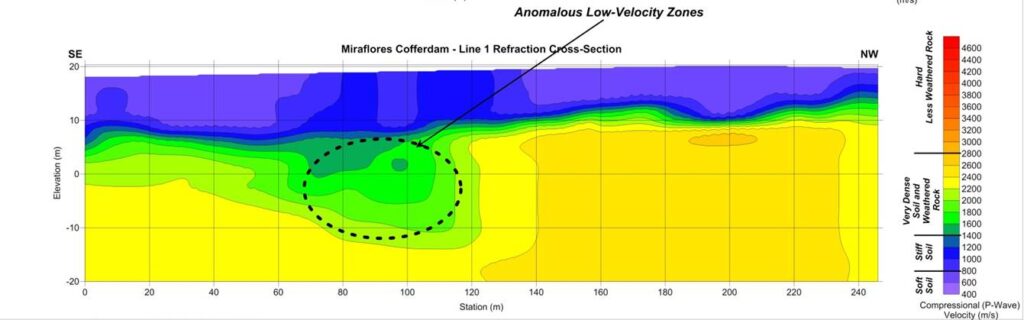
Seismic Refraction involves measuring the travel time of a body wave as it travels through an upper medium and along an interface of an underlying faster medium and then back to the surface. A hammer or explosive is used to generate the seismic wave. As the wave propagates through the subsurface and reaches an underlying, higher velocity stratum, the wave is critically refracted along that interface. A series of geophones is used to record the travel time of the direct and refracted waves as they reach the ground surface. In accordance with Snell’s Law, seismic refraction will be able to image deeper layers only if they have a higher velocity than the overlying layer. The maximum depth limits are typically 100 to 200 feet seismic refraction is commonly used for:
- Mapping overburden thickness
- Determining depth to bedrock
- Determining rippability of bedrock
- Geological investigations